

How Long Does It Take to Fix Dark, Pigmented Lips? (A Realistic Timeline)
Most answers to this question are guesses dressed up as expertise, usually borrowed from research on facial pigmentation and applied to lips because almost nobody measures lips directly. Lip skin is structurally different, so the borrowed numbers are not reliable.
Here is what a measured timeline actually looks like, and where the honest limits of that measurement sit.
The short answer
Instrument-measurable change in lip pigmentation begins within two weeks and roughly doubles by four weeks of consistent twice-daily use.
In a 28-day dermatologist-supervised clinical study of Lip Ritual, melanin index measured by Mexameter fell 14.9% at day 14 and 27.9% at day 28 across 33 participants.
Hydration and texture move faster than tone. That gap is the single most useful thing to understand before you start counting.
Why pigmentation change takes longer than hydration
Two separate processes run at different speeds.
Hydration is immediate. Humectants and conditioning oils act on the surface within minutes. The same study recorded an 18% improvement in lip moisture at 30 minutes, peaking at 33% by two hours.
Pigmentation change is gradual. Ingredients like kojic acid inhibit tyrosinase, the enzyme that produces melanin, so they slow new pigmentation forming. Existing pigmentation clears only as skin naturally turns over. Nothing applied topically removes it directly.
So your lips feel better long before they look meaningfully lighter, which is exactly why people conclude a product is not working when it is.
The measured timeline
Within hours: hydration
Moisture rose 18% at 30 minutes and 33% at two hours, easing back to 25% at eight hours. 97% of participants reported noticing instant hydration.
Day 14: the first measurable tone change
- Melanin index down 14.9%
- Lip dryness down 37.0%
- Lip cracks down 29.9%
- Smoothness up 51.7%
- Hydration up 34.7%
Texture is already improving substantially here. Pigmentation has started moving but the change is more detectable by instrument than by eye.
Day 28: meaningful change
- Melanin index down 27.9%, with all participants showing some reduction
- Hydration up 43.1%
- Lip dryness down 49.3%
- Lip cracks down 40.3%
- Smoothness up 81.0%
At the end-of-study questionnaire, 97% of participants reported that lip pigmentation or dark lips had visibly reduced, and the same proportion said the natural colour of their lips had visibly improved.
Beyond 28 days
The study stopped at day 28, so anything past that point is outside what was measured. Based on how melanin inhibition works, deeper and longstanding pigmentation would be expected to continue improving with continued use rather than stopping at four weeks, but that is reasoning rather than measurement.
What this data does and does not show
Worth being straight about, because most brands quoting clinical numbers skip this part.
What it shows: consistent, measured reduction in melanin and improvement in hydration and texture across 33 people using the product twice daily for 28 days, assessed with standard instruments, supervised by a dermatologist, with no adverse events recorded and zero cases of irritation, itching or redness.
What it does not show: the study was single-arm with no placebo group, so improvements cannot be separated from natural variation with certainty. Results were reported as percentage change without statistical significance testing. Participants averaged 25.7 years old and were selected for normal to dry lips rather than for severe pigmentation specifically. They were also asked to avoid prolonged UV exposure throughout, which likely helped, and which tells you something useful in itself.
If your pigmentation is longstanding, smoking-related or considerably darker than the study population's, your timeline will run longer.
What makes it faster or slower
Faster: recent rather than years-old darkening; surface-level rather than deep pigmentation; trigger removed, whether lip licking, smoking or unprotected sun; twice-daily application without gaps; daytime lip protection.
Slower: continuing to smoke; longstanding darkening; older age, since skin turnover slows; intermittent application; hormonal, nutritional or medication-related causes, where a topical product is treating the wrong thing.
If darkening appears suddenly, affects only one patch, has changed shape or texture, or comes with fatigue and other symptoms, see a doctor rather than waiting out any timeline.
What will not change
Genetic lip tone does not change, and neither do two-tone lips where the upper lip is naturally darker. Both are normal variations rather than conditions. If your lips have always been this colour, no product will alter that baseline.
How to track it properly
Change at this rate is hard to see day to day, which is the main reason people quit early.
- Photograph on day 0, before starting.
- Use natural daylight near a window, no filters, no flash.
- Same time of day, same distance, neutral relaxed expression.
- Repeat on day 14 and day 28.
- Compare only against day 0, never against last week.
Common mistakes
- Applying once daily. The measured results come from twice-daily use. Halving the dose changes the timeline.
- Judging on day 7. Too early for tone, though texture should already feel better.
- Switching products at week three. Restarts the clock.
- Skipping daytime sun protection. Study participants avoided prolonged UV throughout, and sun exposure is a leading cause of lip pigmentation.
- Scrubbing to speed things up. Inflammation on thin lip skin creates more pigmentation.
How Lip Ritual fits
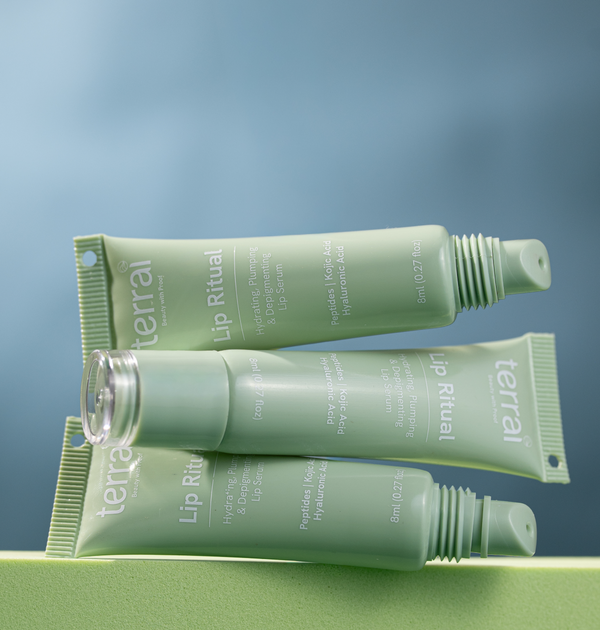
Lip Ritual is the product these numbers come from, tested at two to three applications twice daily over 28 days under dermatologist supervision, with the full study report published on the product page.
The formula pairs kojic acid, vitamin C, licorice leaf extract, green tea extract and a palmitoyl tripeptide on the pigmentation side with hyaluronic acid, olive squalane, jojoba oil and saffron oil for hydration and barrier support. The gloss format matters practically: reapplying through the day is easier with something you would wear anyway, and the results above depend on twice-daily consistency.
One thing to add alongside it. The formula contains no SPF, and study participants were specifically asked to avoid prolonged UV exposure. If sun is one of your triggers, daytime lip protection is part of the timeline, not optional. Terrai covers sun care separately.
The bottom line
Measurable change in lip pigmentation within two weeks, roughly double that in four, with texture and hydration improving well before tone. That is faster than the eight-to-twelve-week figure usually quoted from facial pigmentation research, and it is measured on lips rather than assumed from elsewhere.
Apply twice daily, protect your lips during the day, photograph at day 0, and judge at day 28.
FAQs
How long does it take to fix dark lips?
Measurable change begins within two weeks. In a 28-day clinical study of Lip Ritual, melanin index fell 14.9% by day 14 and 27.9% by day 28 with twice-daily use. Hydration and texture improve sooner. Longstanding or smoking-related pigmentation takes longer than the study period covered.
Why are my lips not getting lighter after two weeks?
Two weeks is early. Instrument-measured change at day 14 is real but subtle to the eye, since existing pigmentation clears gradually through skin turnover. If nothing has shifted by four weeks of consistent twice-daily use, an ongoing trigger such as sun exposure, smoking or lip licking is the likely reason.
How often should I apply lip serum for results?
Twice daily. The clinical results above come from two to three applications twice a day over 28 days, so applying once daily changes the expected timeline. These ingredients work through cumulative contact time, which is why a wearable format tends to outperform a night-only treatment.
Can dark lips become permanently pink again?
Pigmentation from sun, smoking, staining or chronic dryness usually lightens and stays lighter if the trigger is removed and protection continues. Genetic lip tone will not change. Because melanin-inhibiting ingredients are preventive as well as corrective, ongoing maintenance is generally needed.
Does exfoliating make dark lips fade faster?
No, and it often makes things worse. Lip skin is only a few cell layers thick, so scrubbing causes inflammation, and inflammation is one of the main routes to pigmentation. Let skin turnover do the work and avoid physical exfoliation on pigmented lips entirely.

More from the Journal
 A brightening serum gets added to the routine, skin turns pink, flaky or reactive within days, and the assumption is usually that the active...
 Sunscreen goes on the face every morning, and lips get skipped entirely, even though they're just as exposed to UV throughout the day. That...
 A brightening serum goes on for two weeks, nothing visible happens, and it gets shelved as "not working" right around the point it was...