

How to Choose a Sunscreen Shade That Matches Your Skin Tone
Most people pick a tinted sunscreen shade by looking at three swatches on a screen and guessing. Then it turns out grey, or orange, or leaves a visible line at the jaw, and they conclude tinted formulas do not work for them. The sunscreen shade was wrong, not the category, and getting it right takes about five minutes and a window.
The short answer
Match to your jawline in daylight, not to the back of your hand under a bulb, and let the product sit for ten minutes before you judge it.
If you fall between two shades, go slightly deeper rather than lighter. A tint that is too light reads ashy and grey, which is exactly the white cast problem you bought a tinted formula to avoid. A tint that is marginally deep just looks like skin.
Depth and undertone are two different things
This is where most shade matching goes wrong. People choose depth correctly and ignore undertone entirely, then wonder why a technically correct shade still looks off.
Skin depth is how light or deep your skin is. It shifts through the year, especially in India, where sun exposure can move you a full shade between January and May.
Undertone is the colour underneath, and it does not change. It is usually described as warm (golden, yellow), cool (pink, red), neutral (balanced), or olive (a green or grey cast that sits alongside warmth).
A shade can be the right depth and still look wrong if the undertone clashes. That is the mismatch people describe as looking muddy or masky.
Finding your depth
Stand near a window in indirect daylight and compare the product against your jawline, not your cheek. The jaw is where face meets neck, and that is where a mismatch becomes a visible line.
Finding your undertone
Three quick checks, and look for agreement across all three rather than trusting any one:
- Veins at the inner wrist. Green suggests warm, blue or purple suggests cool, a mix suggests neutral.
- Jewellery. If gold consistently flatters you more than silver, you likely lean warm.
- White paper. Hold a sheet of plain white paper beside your bare face in daylight. Skin that looks yellow or golden against it is warm, pink or rosy is cool, and slightly green or grey is olive.
Why Indian skin tones get mismatched so often
Olive and warm undertones are extremely common across South Asian skin, and olive is the one most shade ranges handle badly.
Many international ranges are built around a warm-to-cool axis with no olive option, so olive skin gets pushed towards a warm shade that then reads too orange, or a neutral one that reads too pink. This is the most frequent complaint about foundation and skin tint matching for Indian skin tones, and it carries straight over into tinted sunscreen.
If you have consistently found base products turn orange on you within an hour, an olive undertone is the likely explanation, not oxidation.
How to swatch properly
- Start with clean, bare skin. No existing base product, no primer.
- Apply along the jawline, extending slightly onto the neck. Never the back of the hand, which is usually a different tone from your face entirely.
- Blend it out fully. A thick unblended stripe tells you nothing about how a sheer formula wears.
- Wait ten minutes. Tinted formulas settle as they dry down, and the shade you see immediately is not the shade you will wear.
- Check in daylight, then check again indoors. A shade that matches under one light source and fails under another is a sign the undertone is off, not the depth.
- Look at the jaw-to-neck transition. If there is no visible line, you have your match.
What to do when you are between shades
Between two options, take the deeper one. Sheer tints are more forgiving downward than upward, and a slightly deep shade warms into the skin while a slightly light one greys out.
You can also adjust rather than replace. Mixing a small amount of moisturiser into a shade that is marginally too deep sheers it out. Applying a lighter shade more thinly does not work the same way, because the pigment concentration stays the same.
If your face and neck differ noticeably, which is common when the face gets more sun, match to the neck. It is easier to bring the face down to meet the neck than to explain a line at the jaw.
Why tinted sunscreen is more forgiving than foundation
Worth knowing before you agonise over this: a tinted sunscreen for face is not trying to do what foundation does.
Sheer coverage means your own skin tone shows through and does most of the work. That is why tinted SPF ranges offer three or four shades where foundation ranges offer thirty. Each shade is designed to cover a band of tones rather than one precise point.
That also means shade bands described as ranges, such as light to medium, are describing exactly that: a span the formula is built to blend across, not a compromise.
Common mistakes
- Swatching on the hand or wrist. Almost always a different depth from the face.
- Choosing under shop or bathroom lighting. Artificial light distorts undertone badly, and a shade can match under one source and fail under another.
- Judging on contact. Give it ten minutes to settle.
- Matching to the tone you want. Going a shade lighter to look brighter produces an ashy cast, the opposite of the effect.
- Ignoring the neck. The transition is where a mismatch shows first.
- Never revisiting. If your depth shifts across the year, the shade that worked in December may not in May.
How the Terrai shade range works
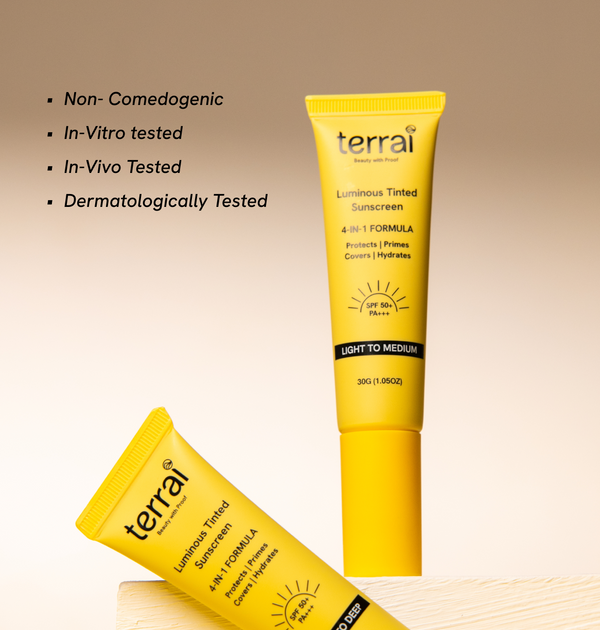
The Luminous Tinted Sunscreen is offered in three shades built around Indian skin tones: extra light to light, light to medium, and medium to deep.
The naming reflects the point above. Each shade is a band rather than a single fixed tone, which is how sheer tinted formulas are designed to work. The tint itself comes from iron oxides, the same pigment family used in foundation, which is what cancels the whiteness of the mineral filters underneath and lets an SPF 50+ PA+++ formula sit without a cast.
The texture supports the matching too. The brand describes it as mousse-like and blending without a cakey finish, and a sheerer formula is far more forgiving of a near-match than a heavy one would be. Squalane, aloe vera and allantoin handle conditioning. The formula is fragranced, worth knowing if your skin reacts easily.
If you are choosing between the bands, the deeper-shade rule applies here as it does anywhere. You can see the full sun care range from Terrai, which includes untinted options if you would rather skip shade matching entirely.
The bottom line
Choosing a sunscreen shade comes down to two questions: how deep is your skin, and what sits underneath it. Get the undertone right and a near-match on depth will disappear. Get the undertone wrong and even a perfect depth match will look off.
Swatch at the jaw, wait ten minutes, check in daylight, and go deeper rather than lighter when you are unsure.
FAQs
How do I know my sunscreen shade?
Swatch along your jawline on bare skin in indirect daylight, blend fully, and wait ten minutes before judging. The right shade disappears at the jaw-to-neck transition with no visible line. Match to your neck rather than your face if the two differ, which is common when the face gets more sun.
Should I choose a lighter or darker tinted sunscreen shade?
Choose the deeper one. Sheer tints blend downward far better than upward. A shade that is too light leaves an ashy, greyish cast, which is the exact problem tinted sunscreen is meant to solve. A marginally deep shade simply warms into the skin and reads natural.
What is an olive undertone?
Olive skin has a subtle green or grey cast alongside warmth, and it is very common across South Asian skin tones. It is frequently mismatched because many shade ranges only offer warm and cool options, so olive skin gets pushed towards shades that turn orange or pink within an hour of wear.
Why does my tinted sunscreen look grey on me?
Usually the shade is too light for your depth, so the mineral pigments are not fully cancelled by the tint. It can also happen if you apply more than needed, since a heavier layer concentrates the pigment. Try the next shade down and apply a thinner, well-blended layer.
Do I need a different sunscreen shade in summer?
Possibly. Depth shifts with sun exposure while undertone stays fixed, and in India that shift across seasons can be significant. If your usual shade starts looking slightly light around April or May, you have moved a band rather than done something wrong.
Shop the products
Related collections


More from the Journal
 A brightening serum gets added to the routine, skin turns pink, flaky or reactive within days, and the assumption is usually that the active...
 Sunscreen goes on the face every morning, and lips get skipped entirely, even though they're just as exposed to UV throughout the day. That...
 A brightening serum goes on for two weeks, nothing visible happens, and it gets shelved as "not working" right around the point it was...