

Kojic Acid for Lips: Does It Actually Lighten Dark Lips?
Kojic acid turns up on almost every lip product marketed for pigmentation now, usually next to a promise about visibly brighter lips in a few weeks. The ingredient does have real mechanism behind it, which is more than can be said for beetroot masks. What it will not do is work as fast as the packaging suggests, or work at all if you are still doing the thing that darkened your lips in the first place.
The short answer
Kojic acid for lips works, gradually and partially, on pigmentation caused by melanin overproduction. It slows the enzyme that makes melanin, so new pigment forms more slowly while existing pigment clears naturally.
Expect a change in tone over roughly eight to twelve weeks of consistent daily use, not days. It will not alter your natural genetic lip colour, and it does nothing about staining sitting on the surface from smoking or tea, which needs the habit addressed rather than an active applied.
What kojic acid actually is
Kojic acid is a compound produced during fermentation by certain fungi, and it was first identified in the brewing of sake and the fermentation of soybeans and rice. It has been used in skincare for decades as a brightening agent.
In cosmetics it is normally used at low single-digit percentages. Regulatory limits apply in several markets, so a product using more is not automatically better, and higher concentrations correlate with more irritation rather than faster results. [Verification required: confirm the specific regulatory limit applicable in India before citing a number.]
How it works on lip pigmentation
Melanin production depends on an enzyme called tyrosinase, which needs copper to function. Kojic acid binds to that copper at the enzyme's active site, which slows the enzyme down.
Less tyrosinase activity means less new melanin. The pigment already present in your lips is not removed by the ingredient. It clears as the skin naturally turns over, which is why results appear gradually rather than immediately.
This also explains a limitation people find frustrating. Kojic acid is preventive as much as corrective. If your trigger is still active, whether that is UV exposure, smoking or chronic lip licking, you are inhibiting new melanin while continuing to stimulate it.
Does it work on lips specifically?
Lip skin is thinner than facial skin, with no oil glands and a much shallower barrier, so actives penetrate readily. That cuts both ways. Absorption is good, and so is the chance of irritation.
Kojic acid also has mild exfoliating and antioxidant activity, which helps with the dullness and rough texture that usually accompany dark lips.
What it cannot do is worth stating plainly. It will not lighten lips beyond their natural baseline tone. It will not fix two-tone lips, which are usually genetic. And it will not resolve pigmentation with a medical cause, such as a deficiency or a drug reaction, which needs a doctor rather than a lip product.
How it compares to other brightening ingredients
|
Ingredient |
How it works |
Notes for lips |
|
Kojic acid |
Inhibits tyrosinase by binding copper |
Well established, mild exfoliating action, can sensitise |
|
Alpha arbutin |
Releases hydroquinone slowly to inhibit tyrosinase |
Gentler, often slower |
|
Vitamin C |
Antioxidant plus pigment inhibition |
Works well alongside kojic acid, less stable |
|
Niacinamide |
Blocks pigment transfer to surface cells |
Different mechanism, so it pairs rather than competes |
|
Licorice extract |
Contains glabridin, a tyrosinase inhibitor |
Gentlest option, useful for reactive lips |
These are complementary rather than rival. Formulas that combine a tyrosinase inhibitor with an antioxidant and a barrier ingredient generally do better on lips than a single active at high strength, because the barrier support prevents the irritation that creates fresh pigmentation.
How to use it on lips safely
- Patch test first. Apply a small amount to one corner of the lip and wait 24 hours. Kojic acid causes contact irritation in a minority of people.
- Use it daily. Intermittent use is the most common reason people conclude it does not work.
- Protect during the day. The mild exfoliating action can increase sun sensitivity, and UV is one of the main causes of lip pigmentation anyway. Extending your sun care routine to the lip line matters more once you start treating.
- Do not stack it with scrubs. Physical exfoliation on already-thin lip skin adds inflammation.
- Give it three months before deciding. Photograph your lips in the same light at week zero, six and twelve, since gradual change is hard to notice day to day.
Who should be cautious
Anyone with a history of contact dermatitis on the lips, anyone currently using a prescription depigmenting treatment, and anyone whose lips are actively cracked or broken should speak to a dermatologist first. Applying an active to a compromised barrier is how irritation becomes pigmentation.
Common mistakes
- Judging it at two weeks. Nothing acting on melanin shows meaningfully that fast.
- Applying only at night. Daytime protection contributes more to lip tone than any overnight treatment.
- Assuming stronger is better. Irritation scales faster than efficacy.
- Ignoring the cause. No active outperforms an ongoing trigger.
How Lip Ritual uses kojic acid
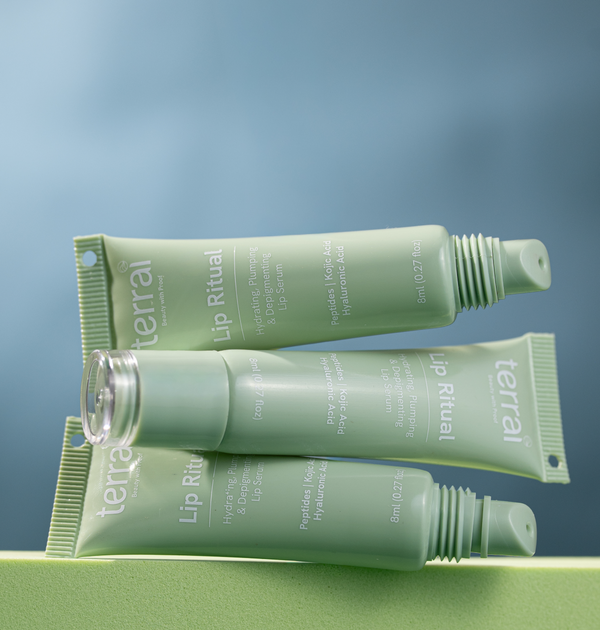
Lip Ritual from Terrai takes the combination approach described above rather than relying on a single active.
Kojic acid sits alongside vitamin C, licorice leaf extract and green tea extract on the pigment and antioxidant side, with a palmitoyl tripeptide included as well. Hyaluronic acid, olive squalane, jojoba oil and saffron oil handle hydration and barrier support, which is the part that stops the treatment itself becoming a source of irritation. The format is a gloss rather than a balm, so the actives stay on the lips through the day instead of only overnight.
The useful detail for anyone evaluating an ingredient claim is the testing. In-vivo studies for lip pigmentation and hydration, dermatological testing, and non-toxic and cruelty-free certifications are published as downloadable reports on the product page. In-vivo means the formula was tested on human volunteers rather than in a lab dish, and very few lip products in this category publish that.
One caveat: the formula contains no SPF, so it treats pigmentation rather than preventing it. Given that kojic acid can raise sun sensitivity, pair it with daytime lip protection.
The bottom line
Kojic acid for lips is one of the few ingredients in this category with a clear, documented mechanism behind it, and it does reduce pigmentation for most people who use it consistently and protect their lips during the day. It is not a lightening treatment in the sense the marketing sometimes implies, and it works over months rather than weeks.
If you want to try it, choose a formula that pairs it with hydration and antioxidants rather than a single high-strength active, check whether the brand publishes any testing, and give it a full season before judging.
FAQs
Does kojic acid really lighten dark lips?
It reduces pigmentation caused by excess melanin, gradually. Kojic acid inhibits tyrosinase, the enzyme that produces melanin, so new pigment forms more slowly while existing pigment clears through natural skin turnover. It will not change your genetic lip tone, and it does not remove surface staining from smoking or tea.
How long does kojic acid take to work on lips?
Most people see a change over eight to twelve weeks of consistent daily use. Texture and hydration usually improve first, with tone following. Because the change is gradual, photographing your lips in the same lighting every few weeks is more reliable than judging by memory.
Is kojic acid safe to use on lips?
It is generally well tolerated at cosmetic concentrations, but lip skin is thin and absorbs readily, so patch test before regular use. Stop if you get persistent stinging, redness or peeling. Avoid it on cracked or broken lips, and speak to a dermatologist if you have a history of contact reactions.
Can I use kojic acid and vitamin C together on lips?
Yes, and they are often formulated together. They act through different routes, kojic acid by inhibiting the pigment-producing enzyme and vitamin C by working as an antioxidant that also interferes with pigment formation. Combined with hydrating ingredients, this tends to work better than one active at high strength.
Does kojic acid make lips sun sensitive?
It can. Kojic acid has a mild exfoliating effect, which can leave lips more reactive to UV. Since sun exposure is itself a leading cause of lip pigmentation, daytime protection is not optional while using it. Extend your sunscreen to the lip line or use a lip product with UV protection.

More from the Journal
 A brightening serum gets added to the routine, skin turns pink, flaky or reactive within days, and the assumption is usually that the active...
 Sunscreen goes on the face every morning, and lips get skipped entirely, even though they're just as exposed to UV throughout the day. That...
 A brightening serum goes on for two weeks, nothing visible happens, and it gets shelved as "not working" right around the point it was...