

Multi-Corrective Serums Explained: Can One Product Really Do It All?
A serum promising to fix dark spots, dehydration, dullness, texture, redness, puffiness and early ageing sounds like it must be diluting something. Sometimes it is. Sometimes it is doing exactly what a well-built formula should. The difference comes down to whether the ingredients inside are competing for the same job or covering different ones, and that is something you can check yourself.
The short answer
Yes, one multi-corrective serum can meaningfully address several concerns at once, but not equally well and not for everyone.
Multi-corrective formulas work when their actives target different pathways. They fail when a brand lists eight impressive ingredients at concentrations too low to do anything, or when it stacks three ingredients that all do the same thing and calls it comprehensive.
What a single face serum will not do is outperform a targeted prescription treatment on a specific severe concern. That is the honest ceiling.
What "multi-corrective" actually means
The term is not regulated, so it means whatever a brand wants it to mean. In practice, a genuine multi-active serum contains actives that work through separate mechanisms.
Pigmentation is a useful example. Melanin production and melanin transfer to surface cells are two different stages. An ingredient that slows production and an ingredient that blocks transfer are not duplicating effort, they are covering the same problem from two angles. Add an antioxidant that reduces the oxidative trigger upstream and you have three ingredients doing three jobs.
Contrast that with a formula containing four separate exfoliating acids. That is one job done four times, with four times the irritation risk and no additional benefit.
Where the real trade-offs sit
Any brand telling you a multi-active serum has no downsides is skipping the interesting part.
Concentration
Formula space is finite. A serum containing twelve actives cannot include all of them at the concentrations used in the studies supporting each one. Something gets reduced.
This is not automatically a problem, because many actives work below their peak studied concentration and combinations can compensate. But it does mean a multi-corrective serum is unlikely to beat a well-formulated single-active product on that one concern.
You cannot isolate a reaction
If your skin objects to a twelve-ingredient serum, you have no way of knowing which ingredient caused it. With separate products you can eliminate one at a time.
This is the strongest argument for buying single-active products if your skin is reactive, and it is why published tolerability testing matters considerably more on a combination formula than on a simple one.
pH and stability
Different actives prefer different conditions. Some are unstable in the presence of others or degrade with light and air. A formula containing many actives has a harder formulation problem than one containing two, which is why packaging and shelf life are worth noticing.
Everything moves at the pace of the slowest thing
Hydration shows within days. Barrier repair takes weeks. Pigmentation takes two to three months. Collagen support takes longer still. A serum addressing all four does not deliver them together, and a reasonable brand will say so.
Where multi-corrective genuinely wins
Fewer preservative and fragrance exposures. One formula means one preservative system rather than four. Since preservatives and fragrances are among the more common causes of contact reactions, consolidating reduces how many times you meet them.
Adherence. A routine you follow beats one you abandon. This is unglamorous but it is probably the largest real-world effect, because most skincare underperforms through inconsistency rather than formulation.
No layering conflicts. Actives combined by a formulator have been assessed together. Actives you layer yourself have not.
Cost and time. One step, one product.
How to judge one before buying
- Read the ingredient order. Actives near the top are present in meaningful amounts. An impressive ingredient listed after the fragrance is present in trace quantities.
- Check whether the actives do different jobs. Two tyrosinase inhibitors is redundancy. A tyrosinase inhibitor plus an antioxidant plus a barrier ingredient is coverage.
- Look for published tolerability data. More actives means more chance of reacting, so irritation and sensitivity testing carries real weight here.
- Be suspicious of claim lists with no timeline. Anything addressing pigmentation and firmness works over months.
- Match it to your actual concerns. If you have one severe issue, targeted treatment usually beats broad coverage.
Who should not buy one
- Anyone with a specific severe concern such as significant melasma or moderate acne, where a dermatologist-directed treatment will outperform a general serum
- Anyone whose skin is currently compromised, since actives go on after the skin barrier is repaired
- Anyone with a history of reacting to skincare, at least until they have identified their triggers with simpler products
- Anyone already using several prescription actives, where combining without medical advice is unwise
How One & Done is built
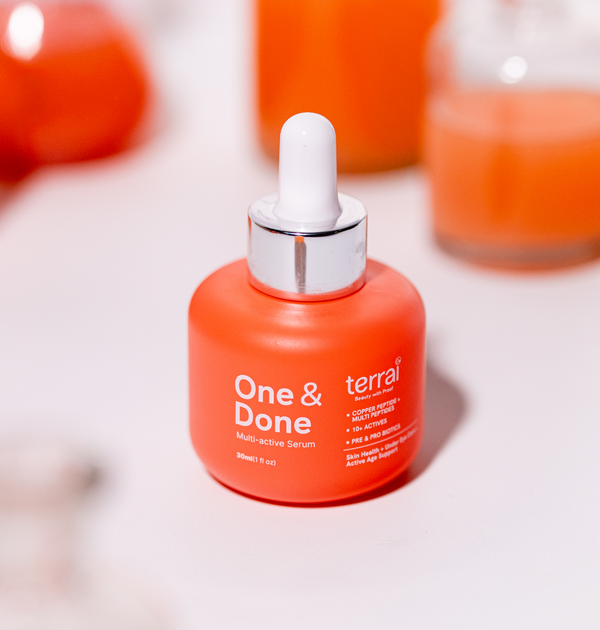
The One & Done Serum is a reasonable case study for the checks above, so apply them rather than taking the description on faith.
On the different-jobs test, it holds up. Niacinamide sits high in the ingredient list and blocks pigment transfer to surface cells; tranexamic acid works upstream on pigment production; ethyl ascorbic acid, a stable vitamin C, plus green tea and bilberry extracts cover the antioxidant side. Those are three stages of the same process, not three versions of one step. Sodium hyaluronate, olive squalane and saccharide isomerate handle hydration. A peptide complex including copper tripeptide-1 and acetyl hexapeptide-8 addresses the structural side, and caffeine is the ingredient behind any claim about under-eye puffiness.
On the tolerability test, the documentation is unusually complete for this category. In-vivo clinical, hypoallergenic and skin irritation study reports are published as downloadable PDFs on the product page. For a formula asking you to consolidate several steps into one, that is the evidence worth reading before buying.
On expectations, the brand's own instruction is telling: two to three drops morning and night, always with SPF in the morning. Nothing here bypasses sun protection, and nothing works on a fortnightly timescale. You can see the rest of the Terrai skincare range alongside it.
What it will not do is outperform a prescription treatment on a severe single concern, and no multi-corrective serum will.
The bottom line
One product can genuinely do several things, provided its actives work through different mechanisms and are present in amounts that matter. The multi-corrective serum category is legitimate; the marketing around it often is not.
Read the ingredient order, check whether the actives overlap or complement, look for tolerability data, and expect different concerns to improve on different timelines. If one issue dominates your skin, treat that specifically instead.
FAQs
Can one serum really treat multiple skin concerns?
Yes, if its actives work through different mechanisms rather than duplicating one another. A formula pairing a pigment inhibitor, an antioxidant and a barrier ingredient covers three angles genuinely. A formula with four exfoliating acids does one job repeatedly, with more irritation and no extra benefit.
Are multi-active serums less effective than single-ingredient ones?
Usually on any single concern, yes, since formula space is limited and concentrations get shared. But they often outperform in practice because people actually keep using them. For one severe, specific concern, a targeted product is the better choice.
Is it safe to use a serum with many active ingredients?
For most people, yes, and often safer than layering several products yourself, since a formulator has assessed the combination. The drawback is that if you react, you cannot identify which ingredient caused it. Look for published irritation and sensitivity testing before buying.
How long before a multi-corrective serum shows results?
Different concerns move at different speeds. Hydration improves within days, barrier repair over weeks, pigmentation over two to three months, and firmness longer still. A brand promising everything within a fortnight is describing hydration and letting you assume the rest.
Do I still need sunscreen with a brightening serum?
Yes, and it matters more, not less. UV exposure reactivates the pigment pathways brightening ingredients work to suppress, so skipping sun protection undoes progress faster than any serum can make it. Sunscreen is the single largest factor in whether pigmentation treatment works.

More from the Journal
 A brightening serum gets added to the routine, skin turns pink, flaky or reactive within days, and the assumption is usually that the active...
 Sunscreen goes on the face every morning, and lips get skipped entirely, even though they're just as exposed to UV throughout the day. That...
 A brightening serum goes on for two weeks, nothing visible happens, and it gets shelved as "not working" right around the point it was...