

Peptides + Tranexamic Acid: Can Anti-Aging and Brightening Work Together?
Short answer up front: yes, and there is no meaningful conflict between them. They act on entirely different cell types through entirely different signals.
The more useful question is which combinations in your routine genuinely do clash, because one of them involves peptides and it catches people out constantly.
Why these two do not compete
Tranexamic acid works on melanocytes, the cells that produce pigment. It interrupts the signalling that tells them to make melanin after UV exposure, and it acts on the vascular component underneath pigmentation too.
Peptides work on fibroblasts, the cells that produce collagen and elastin. They act as messengers instructing those cells to build structural proteins.
Different cells, different signals, different outcomes. There is no shared receptor to compete for and no pathway where one blocks the other. Combining them is closer to running two independent programmes than to mixing two things.
What "peptides" actually covers
The word is used as though it describes one ingredient. It describes a category, and the types do different jobs.
Signal peptides instruct fibroblasts to produce more collagen. Palmitoyl pentapeptide-4 and palmitoyl tripeptide-1 are the common examples. These work through collagen signalling pathways and are the ones with the most support behind them for firmness and fine lines.
Carrier peptides deliver trace minerals the skin needs for repair. Copper tripeptide-1, also called GHK-Cu, is the best known. It supports the skin's natural healing processes and boosts collagen and elastin production.
Neurotransmitter-inhibiting peptides reduce the muscle signalling behind expression lines. Acetyl hexapeptide-8 is the standard one.
A formula containing several types is covering different aspects of ageing rather than repeating one.
The conflict you should actually be asking about
Here is the pairing that matters, and it is not peptides with tranexamic acid.
The confusion stems from one specific interaction: copper peptides and L-ascorbic acid do not play well together. Copper ions can catalyze vitamin C oxidation, reducing the effectiveness of both ingredients. But this is a copper-specific problem, not a peptide-wide problem.
The mechanism is pH. L-ascorbic acid needs a low pH, around 2.5 to 3.5, to penetrate effectively, while peptide bonds are more stable at neutral pH. At low pH the copper can dissociate from the peptide backbone, and the free copper ions become more reactive and potentially irritating.
Two things follow from this.
It is copper-specific. Palmitoyl pentapeptide-4 contains no copper and has no interaction with vitamin C. The same applies to palmitoyl tripeptide-1. Most peptides are fully compatible.
It is form-specific. Vitamin C derivatives sidestep this entirely, because they are formulated at pH 5.0 to 7.0, the same range where peptides thrive. The problem belongs to pure L-ascorbic acid, not to vitamin C as a category.
So if you use a low-pH L-ascorbic acid serum and a separate copper peptide product, separate them. Morning and evening is the usual recommendation. If your vitamin C is a derivative, the issue largely disappears.
The overlap people miss
There is a reason brightening and anti-ageing actives belong in the same routine rather than in competing ones.
UV exposure drives both problems. It triggers the melanocyte signalling that produces pigmentation, and it degrades the collagen that peptides work to rebuild. Inflammation does the same on both fronts.
Treating pigmentation without addressing photoageing, or vice versa, means leaving half the damage from the same cause unaddressed. This is the actual argument for combining these ingredient families, and it is stronger than the convenience argument brands usually lead with.
It also explains why sunscreen matters more than either ingredient. Without it you are treating downstream while the upstream cause continues.
How to combine them
In one formula is simplest, provided the formulator has resolved the pH question. Look for whether the vitamin C is a derivative rather than L-ascorbic acid if copper peptides are present.
In separate products, apply thinnest to thickest, allow around 10 to 15 minutes between applications, and split copper peptides and L-ascorbic acid across morning and evening.
Expect different timelines. Pigmentation responds over two to three months. Collagen support takes longer, often six months before firmness changes are noticeable. A routine addressing both will show one result well before the other, which is normal rather than a sign something is not working.
Common mistakes
- Assuming all peptides conflict with vitamin C. Only copper-containing ones do, and only with L-ascorbic acid.
- Buying a peptide product without checking which peptides. The category is broad and the types do different things.
- Expecting firmness changes on a pigmentation timeline. Collagen is slower.
- Layering a low-pH acid over peptides. Acids destabilise peptide bonds, so give them separate slots.
- Skipping sunscreen. It undermines both halves at once.
How One & Done stacks this
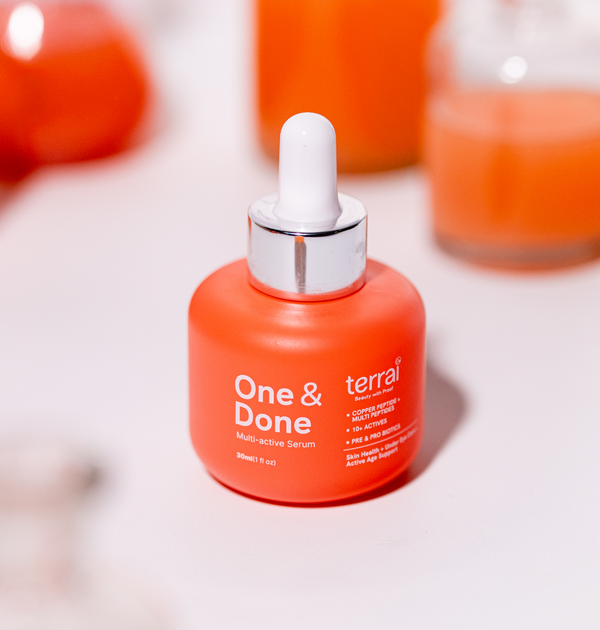
The One & Done Serum is a useful worked example, since it contains both sides of this question and the pH consideration above.
On the brightening side: tranexamic acid, niacinamide positioned high in the ingredient list, and ethyl ascorbic acid, which is a stable vitamin C derivative rather than pure L-ascorbic acid.
On the peptide side: seven peptides across all three classes described earlier. Copper tripeptide-1 as the carrier peptide, palmitoyl pentapeptide-4 and palmitoyl tripeptide-1 as signal peptides, acetyl hexapeptide-8 for expression lines, plus hexapeptide-9, tripeptide-1 and oligopeptide-215.
On the pH question: the formula pairs copper tripeptide-1 with a vitamin C derivative rather than L-ascorbic acid, which is the formulation route that avoids the copper conflict described above. That looks deliberate rather than accidental, though the specific pH is worth confirming with the brand if you want certainty.
In-vivo clinical, hypoallergenic and skin irritation reports are published on the product page, which carries more weight on a formula this layered than on a simple one. Usage is two to three drops morning and night, always with SPF in the morning, and given how much of both problems traces back to UV, that instruction is doing real work. The rest of the Terrai skincare range sits alongside it.
The bottom line
Peptides and tranexamic acid work together without conflict, because they signal different cells to do different things. The pairing is complementary rather than merely compatible, since UV damage drives both pigmentation and collagen loss.
The clash worth knowing about is copper peptides with pure L-ascorbic acid, which is a pH problem rather than a peptide problem, and which vitamin C derivatives avoid entirely. Check which peptides and which form of vitamin C you have, and everything else in this category gets simpler.
FAQs
Can you use peptides and tranexamic acid together?
Yes. Tranexamic acid acts on melanocytes to reduce pigment production, while peptides signal fibroblasts to build collagen. They target different cells through different pathways, so there is no competition or interference. Since UV damage causes both pigmentation and collagen loss, they address two results of the same problem.
Do peptides and vitamin C cancel each other out?
Most peptides work perfectly well with vitamin C. The exception is copper peptides with pure L-ascorbic acid, where copper ions can oxidise the vitamin C and the low pH can destabilise the copper-peptide bond. Vitamin C derivatives formulated at higher pH avoid this entirely.
What is the difference between signal peptides and copper peptides?
Signal peptides such as palmitoyl pentapeptide-4 instruct skin cells to produce more collagen. Copper peptides such as copper tripeptide-1 are carrier peptides that deliver copper, supporting the skin's natural healing processes alongside collagen and elastin production. They complement rather than duplicate each other.
How long do peptides take to work?
Longer than brightening ingredients. Pigmentation typically responds over two to three months, while collagen-related changes in firmness usually take around six months to become noticeable. A product addressing both will show tone improvements well before texture and firmness ones.
Should I use brightening and anti-ageing products at different times?
Not usually. The exception is pairing copper peptides with a low-pH L-ascorbic acid serum, where a morning and evening split is sensible. Otherwise, both ingredient families work fine in the same routine, and combining them addresses UV damage more completely than either alone.

More from the Journal
 A brightening serum gets added to the routine, skin turns pink, flaky or reactive within days, and the assumption is usually that the active...
 Sunscreen goes on the face every morning, and lips get skipped entirely, even though they're just as exposed to UV throughout the day. That...
 A brightening serum goes on for two weeks, nothing visible happens, and it gets shelved as "not working" right around the point it was...