

Post-Acne Marks, Dullness, Uneven Tone: Are They All the Same Fix?
You have been using a brightening serum for two months and your skin is no clearer. There is a reasonable chance you are treating the wrong thing. These three concerns get lumped together as "uneven skin" and sold one solution, but they come from different biological processes, and one of them does not respond to brightening ingredients at all.
The short answer
No. There is real overlap, sun protection and barrier health help all of them, but the specific treatments differ.
The most consequential mistake is treating red marks as though they were brown ones. Treating PIH as PIE leads to stalled progress, whilst treating PIE as PIH often causes unnecessary irritation. Getting the identification right takes about ten seconds and saves months.
The four things people confuse
1. Post-inflammatory hyperpigmentation (brown marks)
The flat brown, tan or grey marks left where a spot was. Inflammation triggers cytokines that stimulate melanocytes, producing more melanin and brown or grey discoloration. This is especially common in people with darker skin types.
PIH affects around 70% of Black, 27% of Asian and 3% of Latin populations, with heightened severity in darker skin tones. For Indian skin, this is the default outcome of almost any inflammation.
Responds to: melanin-inhibiting ingredients, and sun protection above all. Left alone, it usually fades within six to twelve months.
2. Post-inflammatory erythema (red or pink marks)
The pink, red or purple marks that also sit exactly where a spot was. These result from inflammation damaging the small superficial blood vessels in the skin. It is a vascular problem, not a pigment one.
Brightening ingredients do very little here, because there is no excess melanin to inhibit. This is the single most common reason people conclude their serum is not working.
3. Dullness
Not a mark at all. Dullness is about how light reflects off the surface, and it comes from dead cell buildup, dehydration and a compromised barrier rather than from pigment.
It is also the fastest to change. Hydration alone can shift dullness within days, which is why people sometimes credit a brightening serum with fading pigmentation when what actually improved was surface hydration.
4. Textural scarring
Indentations, rolling or pitted areas. This is lost collagen and structural change, not discolouration. No topical product resolves it, and any that claims to is overselling. This needs procedures such as microneedling, resurfacing or subcision from a qualified practitioner.
The ten-second test
Apply direct pressure to the mark. PIE will blanch under pressure due to its vascular nature, while PIH will not.
Press a fingertip firmly on the mark and lift. If it goes pale and then refills with colour, it is vascular, so PIE. If the colour stays put, it is pigment, so PIH.
Two further clues. Run a finger over it: if you feel a dip or ridge, that is textural and neither treatment applies. And check the light: if your skin looks flat and tired overall rather than spotted in specific places, that is dullness.
Both can also coexist, and irritation can worsen either one. Most people with post-acne marks have some combination.
What actually treats each
|
What it is |
What helps |
Timeline |
|
|
Brown marks (PIH) |
Excess melanin |
Tyrosinase inhibitors, niacinamide, tranexamic acid, retinoids, daily SPF |
2 to 3 months, sometimes longer |
|
Red marks (PIE) |
Damaged capillaries |
Time, anti-inflammatories, barrier repair, avoiding irritation |
Often resolves on its own |
|
Dullness |
Surface and hydration |
Hydration, antioxidants, gentle exfoliation |
Days to weeks |
|
Textural scarring |
Lost collagen |
In-clinic procedures |
Not treatable topically |
Two notes worth having. PIE often resolves on its own, meaning one of the most important factors in treating it is time, though vitamin C may speed it up. And emerging research suggests tranexamic acid may have applications in managing post-inflammatory erythema, potentially by reducing vascular endothelial growth and inflammation, which makes it one of the few ingredients with a plausible case on both sides.
What genuinely overlaps
Three things help regardless of which you have, and they matter more than ingredient selection.
Sun protection. Both PIE and PIH can worsen with UV exposure or skin trauma, so avoiding picking and using SPF daily is critical for prevention and healing.
Barrier repair. Inflammation created these marks. A compromised skin barrier generates more inflammation, which generates more marks. Fixing the barrier stops the cycle regardless of type.
Not picking. Picking or popping pimples further damages blood vessels and leads to erythema. It also deepens hyperpigmentation and creates textural scarring. It is the single highest-leverage change available.
Set expectations honestly
Worth knowing before you start counting weeks. Current evidence shows unsatisfactory rates of complete response across all modalities: complete response reaches 18.1% for laser and energy devices, 5.4% for topicals and 2.4% for combination therapies, while partial response reaches 84.9% for combination therapies, 72.4% for topicals and 61.2% for laser. Most patients achieve partial improvement rather than complete resolution.
Read that carefully. Partial improvement is the normal outcome, including from in-clinic procedures. Complete clearing from a topical alone is uncommon. That is not an argument against treating, it is an argument against expecting a serum to erase everything.
Where One & Done fits
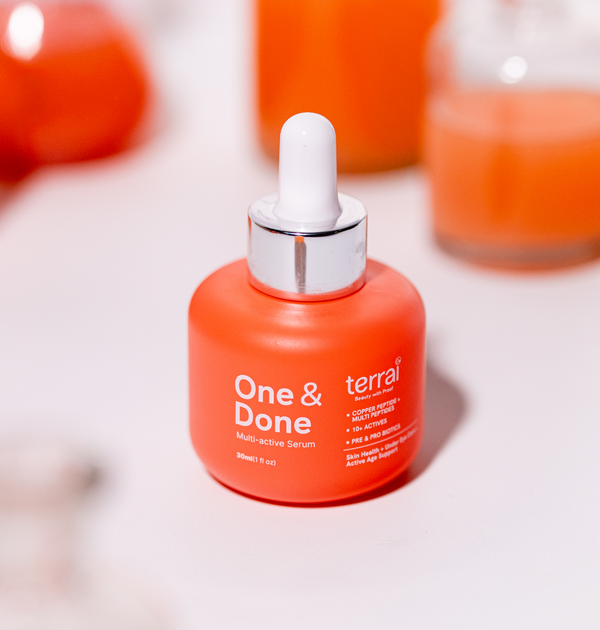
The One & Done Serum addresses two of the four categories above properly, and it is worth being precise about which.
For brown marks and uneven tone, this is the relevant part of the formula. Niacinamide, high in the ingredient list, blocks pigment transfer to surface cells. Tranexamic acid works upstream on pigment production, and has that emerging vascular application too. Ethyl ascorbic acid, a stable vitamin C, plus green tea and bilberry extracts cover the antioxidant side.
For dullness, sodium hyaluronate, olive squalane and saccharide isomerate handle the hydration side, which is what shifts surface dullness fastest.
For red marks, the picture is partial. Niacinamide's anti-inflammatory action and barrier support help the underlying conditions, but PIE resolves largely on its own timeline, and no serum shortcuts that reliably.
For textural scarring, nothing here helps, and nothing topical would.
In-vivo clinical, hypoallergenic and skin irritation reports are published on the product page, which matters when your barrier is already compromised from acne. The brand's instruction is two to three drops morning and night with SPF in the morning, and the SPF is not optional given how much of this depends on UV. The rest of the Terrai skincare range sits alongside it.
The bottom line
Press the mark. If it blanches, it is vascular and needs time and calm rather than brightening actives. If it does not, it is pigment and responds to melanin-inhibiting ingredients over two to three months. If you feel a dip, it is textural and needs a clinic. If your skin is flat overall rather than spotted, it is dullness and hydration will move it within days.
Sunscreen, barrier repair and not picking help all of them, and matter more than which serum you choose.
FAQs
How do I know if my acne marks are red or brown?
Press firmly on the mark with a fingertip and lift. If it goes pale then refills, it is post-inflammatory erythema, a vascular issue from damaged capillaries. If the colour stays put, it is post-inflammatory hyperpigmentation from excess melanin. Many people have both at once.
Why is my brightening serum not fading my acne marks?
The most likely reason is that your marks are red rather than brown. Brightening ingredients inhibit melanin production, so they have little effect on redness caused by dilated blood vessels. Inconsistent sun protection is the second most common reason, since UV reactivates the pigment pathway.
Are dullness and uneven tone the same thing?
No. Dullness is about how light reflects off the skin surface and comes from dead cell buildup, dehydration and barrier disruption. Uneven tone means patches of differing colour caused by pigment. Dullness improves within days from hydration; pigment takes two to three months.
Do post-acne marks go away on their own?
Often, slowly. Post-inflammatory hyperpigmentation usually fades within six to twelve months without treatment, and post-inflammatory erythema frequently resolves by itself. Treatment speeds both up. Textural scarring, meaning indentations you can feel, does not resolve on its own and needs in-clinic procedures.
Can one serum treat post-acne marks, dullness and uneven tone together?
It can address brown marks, dullness and uneven tone, since these respond to pigment inhibitors, antioxidants and hydration that work well together. Red marks respond only partially, mainly through barrier support and anti-inflammatory action. Textural scarring does not respond to topical treatment at all.

More from the Journal
 A brightening serum gets added to the routine, skin turns pink, flaky or reactive within days, and the assumption is usually that the active...
 Sunscreen goes on the face every morning, and lips get skipped entirely, even though they're just as exposed to UV throughout the day. That...
 A brightening serum goes on for two weeks, nothing visible happens, and it gets shelved as "not working" right around the point it was...