

Sunscreen Mist vs Cream: Do Setting Sprays with SPF Actually Work?
The appeal is obvious. It is 2 pm, you are wearing makeup, and nobody wants to rub cream sunscreen over a finished face. A few spritzes of an SPF mist feels like it solves the problem. Whether it actually does depends almost entirely on how you use it, and the honest answer involves a caveat: the category does not always volunteer.
The short answer
An SPF mist works as a reapplication layer over an existing base of cream sunscreen. It does not work as your only sun protection.
The reason is dosage. SPF ratings are earned in laboratory testing at a specific application density, and a few passes of a fine mist do not come close to that amount. Used as a top-up, a mist is genuinely useful. Used as your morning SPF, it gives you a fraction of the number on the bottle and a full sense of security.
The catch the category does not always own up to
This is worth quoting plainly, because it is the crux of the whole question. As board-certified facial plastic surgeon Dr. Sarmela Sunder has put it, with facial sprays containing SPF you generally do not get enough product onto the skin for it to behave at that SPF level, so people end up with a false sense of security and do not apply enough.
That is not an argument against SPF mists. It is an argument against treating one as a substitute for the base layer.
Why the numbers assume an amount you cannot mist on
SPF is measured at an application density of 2 mg per square centimetre of skin. For a face and neck, that works out to roughly a quarter teaspoon, or two finger-lengths of cream.
Try to deliver that volume through a fine mist and you would be soaking your face. Most people apply a single quick spritz, which is a small fraction of the tested dose. Protection does not scale down neatly either. It drops faster than the shortfall, so half the amount delivers considerably less than half the protection.
So where do mists genuinely earn their place?
Three situations, and they are real ones.
Reapplication over makeup. This is the main event. If you wear foundation or a tinted base, you physically cannot rub cream sunscreen on top without destroying it. A mist is the only format that lets you top up without touching your face.
Mid-day, in an office or a car. Most people skip reapplication entirely because of the friction involved. A mist that lives in a bag removes that friction, and a top-up that actually happens beats a perfect one that does not.
Hot, humid conditions. Sweat and sebum lift a sunscreen film through the day. A mist restores some of what has been lost without adding a heavy layer over skin that is already damp.
Mist vs cream
|
SPF mist |
Cream sunscreen |
|
|
Suitable as base layer |
No |
Yes |
|
Reapplication over makeup |
Yes, the only practical option |
No |
|
Achievable dose |
Well below tested density |
Achievable with effort |
|
Coverage accuracy |
Hard to judge, easy to miss patches |
Visible while applying |
|
Portability |
High |
Moderate |
|
Best role |
Top-up layer |
Primary protection |
How to use an SPF mist so it actually contributes
Technique makes a substantial difference here, and most people use these wrong.
- Shake it properly. At least ten seconds. UV filters settle, and an unshaken bottle sprays uneven product.
- Hold it close. A few centimetres from the skin, not at arm's length. Distance means most of the product never lands.
- Do multiple passes in a criss-cross pattern. Horizontal, then vertical. One quick spritz across the face is not a reapplication.
- Aim for the skin to look faintly damp, not glistening wet, but visibly misted. If you cannot tell you applied anything, you did not apply enough.
- Close your eyes and hold your breath during application, and avoid spraying directly towards the nose and mouth.
- Let it settle before blotting or adding anything on top.
What a mist should never be
Your morning sunscreen. Start the day with a cream or fluid SPF applied at a proper dose, and treat the mist as maintenance on top of it.
A mist also should not be your only protection during long outdoor exposure. If you are at a beach or spending hours in direct sun, reapply properly with a cream, even if it means redoing your makeup.
Common mistakes
- One spritz and done. The single most common error, and the reason the format has a mixed reputation.
- Spraying from arm's length. Most of the product ends up in the air.
- Using it as the base layer. No mist delivers a full SPF dose on its own.
- Skipping the shake. Settled filters mean uneven protection.
- Assuming a hydrating mist with SPF replaces sunscreen. It supplements it.
- Not reapplying at all because the mist "did not feel like much". Some top-up is meaningfully better than none.
How Hydra Glow Mist fits
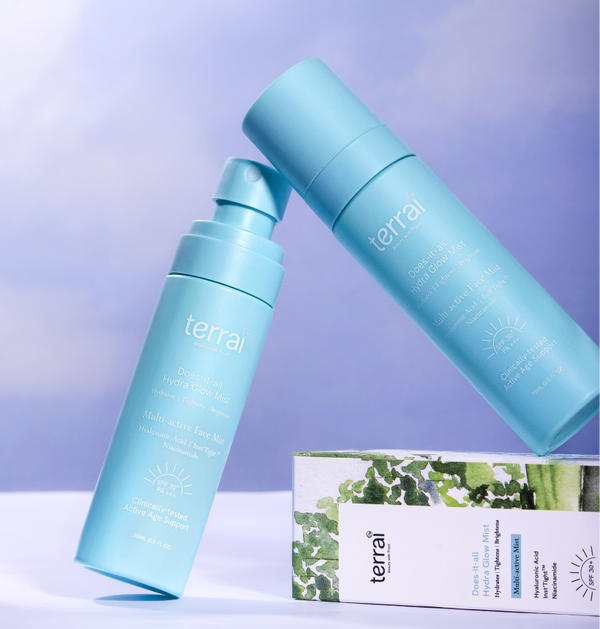
The Hydra Glow Mist is positioned for exactly the role described above. The brand frames it as making sunscreen reapplication easier rather than as a standalone sunscreen, which is the accurate way to think about any SPF mist.
It carries SPF 30+ PA+++ alongside its main function as a hydrating face mist, described by the brand as clinically proven for 24-hour hydration with additional benefits for firmness, brightness and pigmentation.
The practical implication is straightforward. Use a full-strength SPF 50 formula as your morning base, then use the mist through the day over makeup or bare skin to maintain protection and hydration. The two are not alternatives, they are sequential steps. You can see the full sun care range from Terrai, which covers the base-layer formats.
The bottom line
SPF setting sprays do work, within a defined role. As a mid-day top-up over makeup they solve a problem no other format solves, and a reapplication you actually perform is worth more than a theoretically superior one you skip.
They do not work as a replacement for properly applied cream sunscreen, and any product suggesting otherwise is overselling. Apply cream in the morning, keep a face mist with SPF in your bag, hold it close, and use several passes rather than one.
FAQs
Do SPF setting sprays actually protect your skin?
They contribute meaningfully as a reapplication layer but should not be your only protection. Dermatologists note that facial sprays rarely deliver enough product to reach the SPF on the label, which can create a false sense of security. Apply a cream sunscreen in the morning and use a mist to top up.
Can I use a sunscreen mist instead of cream sunscreen?
No. SPF ratings are tested at an application density that a fine mist cannot practically deliver, so you would receive a fraction of the labelled protection. Use a cream or fluid formula as your base layer and treat the mist as maintenance through the day.
How many sprays of SPF mist do I need?
Enough that your skin looks faintly damp, which usually means several passes rather than one spritz. Hold the bottle a few centimetres from your face and work in criss-cross passes, horizontal then vertical, so you do not leave gaps. If you cannot tell you applied it, you have not applied enough.
How do I reapply sunscreen over makeup?
An SPF mist is the most practical option, since rubbing cream over foundation disturbs it. Shake the bottle, hold it close, mist in overlapping passes, and let it settle before blotting. For long outdoor exposure, reapply properly with cream even if it means redoing your base.
Is SPF 30 enough in a face mist?
For a top-up layer over an SPF 50 base, yes. The mist is reinforcing protection that is already there rather than providing it from scratch. What matters more is applying enough of your morning sunscreen and reapplying often enough, rather than the SPF number on the mist itself.


More from the Journal
 A brightening serum gets added to the routine, skin turns pink, flaky or reactive within days, and the assumption is usually that the active...
 Sunscreen goes on the face every morning, and lips get skipped entirely, even though they're just as exposed to UV throughout the day. That...
 A brightening serum goes on for two weeks, nothing visible happens, and it gets shelved as "not working" right around the point it was...