

The Lip Barrier Is Thinner Than You Think: Why Lips Age and Pigment Faster Than Skin
Lips crack, darken and show fine lines well before the rest of the face does, and it isn't because they're neglected more than facial skin. It's because lip skin is built differently from the start, with less natural defense against the same daily exposure. Understanding that difference changes what actually helps, and why products formulated for facial skin often underperform when used on lips.
The short answer
Lip skin has a much thinner outer layer than facial skin and essentially no oil glands, which means it loses moisture faster, has less natural protection against UV and friction, and shows visible ageing and pigmentation sooner. Lip care that accounts for this difference, rather than treating lips like an extension of facial skin, tends to hold up better over time.
Why lip skin behaves so differently
A much thinner outer layer
The outermost layer of skin, the stratum corneum, is what mainly protects against moisture loss and outside irritants. On facial skin, this layer is made up of many cell layers stacked together. On lips, that same layer is considerably thinner, generally described as only a handful of cell layers rather than the dozens found elsewhere on the face.
A thinner barrier means less of a buffer between the environment and the living tissue underneath. Moisture escapes faster, irritants penetrate more easily, and the visible effects of dryness, cracking and sensitivity show up sooner than they would on facial skin exposed to the same conditions.
No oil glands means no built-in moisture seal
Facial skin has sebaceous glands that produce oil, which helps form a natural barrier that slows moisture loss and keeps the surface somewhat self-lubricating. Lips have little to no sebaceous gland activity, so that built-in seal essentially doesn't exist.
This is the main reason lips dry out faster than the rest of the face, especially in cold or dry conditions, and why lip products tend to rely more heavily on occlusive and emollient ingredients to do the job oil glands would otherwise handle. It's also part of why licking dry lips provides only momentary relief and tends to make dryness worse: saliva evaporates quickly and leaves lips drier than before, with nothing underneath to compensate.
Less melanin, less natural UV defence
Lips generally contain less melanin than surrounding facial skin. Melanin isn't just about colour; it also provides some natural absorption of UV radiation.
With less of that natural defence, lips are more vulnerable to UV-driven damage, including the kind that leads to pigmentation and premature ageing, per unit of sun exposure compared with facial skin. This is also part of why lip pigmentation can develop even in people who are otherwise diligent about facial sunscreen, since lips are frequently the one area left unprotected.
Constant movement adds mechanical stress
Lips move almost continuously through the day: talking, eating, drinking and expressions all put repeated mechanical stress on tissue that already has less structural cushioning than facial skin. Combined with a thinner barrier, this repeated flexing is thought to contribute to why fine lines tend to appear on and around lips earlier than on smoother, less mobile areas of the face.
What this means for how you treat your lips
- Facial moisturiser isn't a substitute for lip-specific hydration. Textures formulated for facial skin often aren't designed to compensate for the total absence of natural oil production on lips.
- Sun protection on lips matters as much as it does on facial skin, arguably more. Lower natural melanin content means less inherent defence against the same UV exposure.
- Frequent, consistent reapplication matters more than one heavy application. Because moisture escapes faster through a thinner barrier, topping up through the day tends to work better than a single thick layer in the morning.
- Gentle treatment matters more than it might seem. A barrier that's already thinner has less margin for irritation from harsh exfoliants or aggressive scrubbing.
Common mistakes that make it worse
- Licking dry lips. Saliva evaporates fast and leaves lips more dehydrated than before, on a barrier that already struggles to retain moisture.
- Scrubbing to remove flaky skin. Lip skin's thinness means mechanical exfoliation causes inflammation more easily than it does on facial skin, and inflammation is a known trigger for pigmentation.
- Skipping SPF on lips. With less natural melanin protection, unprotected lips are arguably more exposed to UV-driven pigmentation and ageing than facial skin left unprotected for the same amount of time.
- Using facial anti-ageing products on lips. Formulas built for thicker facial skin aren't necessarily suited to a barrier this much thinner, and some active ingredients can be more irritating on lips as a result.
- Treating dryness as purely cosmetic. A compromised lip barrier is more prone to cracking, which can be uncomfortable and, in some cases, a route for further irritation.
How Lip Ritual is built around this
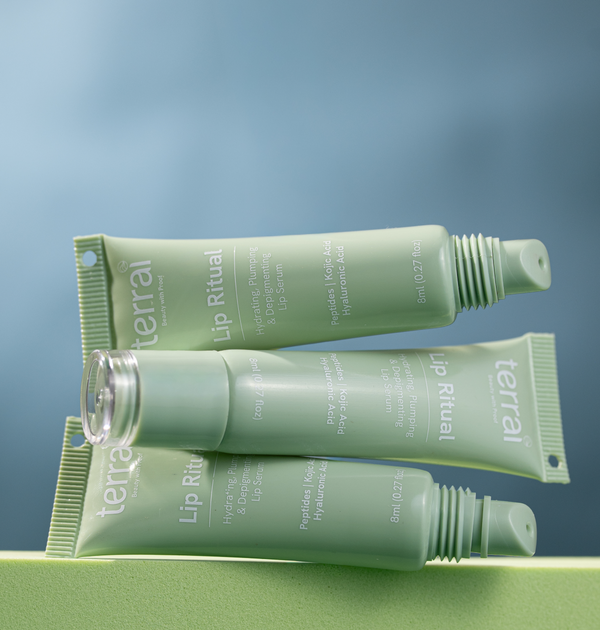
The Lip Ritual formula is built as a multi-layer hydration system specifically because a single ingredient can't compensate for the total lack of natural oil production on lips. Hyaluronic acid draws moisture in, olive squalane helps reinforce the barrier without feeling heavy, and jojoba oil and saffron oil add further emollient support, working together to cover more of what oil glands would otherwise provide.
The gloss format is a practical response to how lips actually behave day to day. Because moisture loss happens continuously through natural movement and environmental exposure, a format easy to reapply through the day supports the barrier more consistently than a single morning application would.
One point worth being direct about: Lip Ritual doesn't contain SPF. Given how much less natural UV defence lips have compared with facial skin, daytime sun protection for lips is a separate, necessary step alongside barrier support rather than something this formula addresses on its own. Terrai's sun care collection covers that separately.
Final word
Lips age and pigment faster than facial skin because they're structurally set up to, with a thinner barrier, no oil glands and less natural UV defence doing the work facial skin gets largely for free. Treating lips as their own category, rather than an afterthought to a facial routine, is what actually slows the visible effects of that difference.
If a hydration system built around that thinner barrier is what you're after, take a look at Lip Ritual and pair it with daytime sun protection for the fuller picture.
FAQs
Why do lips age faster than the rest of the face?
Lip skin has a much thinner outer layer than facial skin and virtually no oil glands, so it loses moisture faster and has less natural cushioning against repeated movement. Combined with lower melanin content and less inherent UV defence, these factors together cause visible ageing to show up sooner on lips than on facial skin.
Do lips have oil glands like the rest of the face?
No, or close to none. Facial skin has sebaceous glands that produce oil and help form a natural moisture barrier, while lips have little to no equivalent. This is a major reason lips dry out faster than facial skin and rely more on external hydration and emollient ingredients.
Why do my lips get dry so much faster than my skin?
Lip skin's thinner outer layer allows moisture to escape more quickly, and the absence of oil glands means there's no natural seal to slow that loss. Environmental factors like cold or dry air, along with habits like lip licking, add to moisture loss on a barrier that already has less built-in protection.
Does lip skin need sun protection even though it looks different from facial skin?
Yes. Lips generally contain less melanin than surrounding facial skin, which means less natural absorption of UV radiation. That lower natural defence makes daytime lip protection important, even though many sun care routines focus only on the face.
Can lip pigmentation be prevented, or does it just happen with age?
Lip pigmentation is influenced by UV exposure, irritation and mechanical stress such as scrubbing or lip licking rather than being purely age-related. Since lips have less natural UV defence than facial skin, consistent sun protection and gentle care both play a meaningful role in reducing new pigmentation forming over time.

More from the Journal
 A brightening serum gets added to the routine, skin turns pink, flaky or reactive within days, and the assumption is usually that the active...
 Sunscreen goes on the face every morning, and lips get skipped entirely, even though they're just as exposed to UV throughout the day. That...
 A brightening serum goes on for two weeks, nothing visible happens, and it gets shelved as "not working" right around the point it was...