

Tinted vs Regular Sunscreen: Which One Should You Use?
Both protect your skin from UV. Only one also solves the white cast problem, and only one is easy to reapply at 3 pm without redoing your face. The tinted vs regular sunscreen question is not really about which protects better, because a well-formulated SPF 50 does its job either way. It is about what else you need the product to do, and what you are willing to trade for it.
The short answer
Choose a tinted sunscreen if white cast has been your problem, if you want to skip foundation, or if you are managing pigmentation and melasma.
Choose a regular untinted sunscreen if you reapply through the day, if you wear full makeup over your SPF, if you need something for body as well as face, or if shade matching sounds like a hassle you do not want.
Plenty of people use both: tinted on working days, untinted on weekends and for reapplication.
What actually differs
|
Tinted sunscreen |
Regular sunscreen |
|
|
UV protection |
Same, depends on SPF and PA rating |
Same, depends on SPF and PA rating |
|
White cast |
Cancelled by iron oxide pigments |
Depends on filter type |
|
Visible light |
Added protection from iron oxides |
None from filters alone |
|
Coverage |
Light to medium, often replaces base makeup |
None |
|
Shade matching |
Required |
Not required |
|
Reapplication |
Harder, disturbs coverage |
Straightforward |
|
Body use |
Impractical |
Practical |
The UV row is the one people get wrong. A tint adds no SPF. Protection comes from the filters, so an SPF 50 tinted and an SPF 50 untinted formula offer comparable UV defence when applied at the same thickness.
What tinted sunscreen does that untinted cannot
It cancels white cast at the source
Mineral filters, zinc oxide and titanium dioxide, are white pigments. They protect by scattering UV, and on medium to deep Indian skin tones they can leave an ashy veil.
A tinted sunscreen adds iron oxides, the same pigments used in foundation, which neutralise that whiteness. You keep the mineral protection without the grey finish. An untinted mineral formula can only reduce cast by micronising particles, never eliminate it.
It protects against visible light
This is the argument most comparison posts miss. UV filters, mineral or organic, do very little against visible light, which research links to pigmentation in deeper skin tones.
Iron oxides do offer protection here. If you are dealing with melasma, post-acne marks or stubborn hyperpigmentation, this is a genuine reason to choose tinted over regular rather than a marketing angle. It is also why dermatologists often specify tinted formulas for melasma patients rather than leaving the choice open.
It removes a step
A tinted SPF that gives light to medium coverage replaces foundation for many people. One layer instead of two means less product sitting on the skin, which matters if you are oily or breakout-prone.
It also means the SPF actually gets applied properly. When sunscreen and base makeup are separate steps, most people skimp on the first to save time for the second.
Where regular sunscreen wins
Reapplication. You should be reapplying through the day. Rubbing a tinted formula over an existing layer moves the pigment around and looks patchy. An untinted fluid, or a mist, goes over the top far more easily.
No shade matching. Even a good three-shade range cannot fit everyone precisely. An untinted formula sidesteps the problem entirely.
Under heavy makeup. If you wear full coverage foundation anyway, the tint underneath is redundant.
Body. Nobody is tinting their arms. For neck, hands, shoulders and legs, untinted is the only sensible choice.
Higher PA options. Some untinted formulas reach PA++++, the highest UVA rating available, while many tinted formulas sit at PA+++.
Which should you use?
Work backwards from your day rather than from your skin type. The format you will actually apply every morning beats the one that looks better on paper.
- Oily or combination skin, cast has been the issue: tinted, in a non-comedogenic tested formula.
- You are treating melasma or dark spots: tinted, for the visible light protection.
- You are outdoors for long stretches: untinted, because reapplication matters more than coverage.
- You wear full makeup daily: untinted underneath.
- You want the fewest possible steps in the morning: tinted.
- Deep skin tone and no shade fits: untinted with organic filters, which are colourless.
Common mistakes
- Assuming the tint adds protection. It does not add SPF. Check the number.
- Applying less because it looks like makeup. Coverage builds up long before UV protection does. Use the same quantity you would with any SPF, roughly two finger-lengths for face and neck.
- Choosing a shade in indoor lighting. Swatch along the jaw in daylight, never on the back of the hand.
- Skipping reapplication because you do not want to ruin the finish. Use a mist over the top instead.
- Treating a tint as a substitute for lip and eye protection. Neither gets covered.
How the Terrai range handles this
The Terrai sun care collection carries both formats, so the choice is about routine rather than availability.
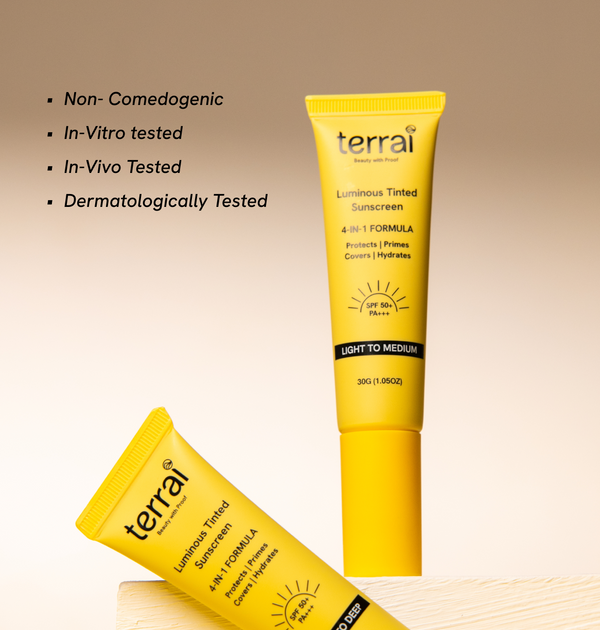
On the tinted side, the Luminous Tinted Sunscreen is a hybrid SPF 50+ PA+++ formula. It pairs titanium dioxide at 6% and micronised zinc oxide at 5% with organic filters, tinted using iron oxides across three shades built for Indian skin: extra light to light, light to medium, and medium to deep. The brand describes the texture as mousse-like, blending without white cast or a cakey finish, and it is positioned as a one-step product that protects, primes, covers and hydrates. Squalane, aloe vera and allantoin handle the conditioning side. Note that the formula is fragranced, worth checking if your skin reacts easily.
What is unusual is the paperwork. In-vivo SPF testing, in-vitro SPF and PA rating, non-comedogenic testing and dermatological safety reports are published as downloadable PDFs on the product page. In-vivo means tested on human volunteers rather than a synthetic plate, and it is rare to see it published in this category.
For untinted options and for reapplication over tint, the same collection covers a water-light formula and an SPF mist, both from a brand that formulates and manufactures in house. You can read more about how Terrai approaches this on the brand's about page.
The verdict
Neither format is better in the abstract. Tinted wins on cast, coverage and visible light protection. Untinted wins on reapplication, versatility and simplicity.
If you are choosing one, pick based on the problem that actually stops you wearing sunscreen. If white cast or a two-step morning is what puts you off, tinted solves it. If reapplication is your sticking point, untinted will serve you better. Whichever you choose, SPF 50 and a PA rating of at least three pluses is the floor, and published test data is what separates a real claim from a printed one.
FAQs
Is tinted sunscreen better than regular sunscreen?
Neither is better overall. They protect equally at the same SPF and PA rating. Tinted formulas add iron oxides, which cancel white cast and offer some protection against visible light, useful for pigmentation. Untinted formulas are easier to reapply, need no shade matching, and work on the body. Choose based on your routine.
Does tinted sunscreen have more SPF protection?
No. The tint comes from iron oxide pigments, which add colour and some visible light defence, but contribute nothing to the SPF number. UV protection comes entirely from the filters. An SPF 50 tinted formula and an SPF 50 untinted formula protect comparably when applied at the same thickness.
Can tinted sunscreen replace foundation?
For many people, yes. A tinted SPF with light to medium coverage evens out tone enough to skip base makeup, which means one less layer on the skin. It will not cover heavy pigmentation or blemishes the way full coverage foundation does, so use concealer where needed.
How do I reapply tinted sunscreen without ruining my makeup?
Use an SPF face mist over the top rather than rubbing in more cream, which shifts the pigment and looks patchy. Mist evenly, let it settle, and avoid blotting straight after. If you need meaningful reapplication before long outdoor exposure, reapplying properly beats preserving the finish.
Is tinted sunscreen good for oily skin?
Yes, provided it is non-comedogenic tested and the shade matches. Tinted formulas suit oily skin well because replacing foundation means fewer layers overall. Check the ingredient list for heavy oils and waxes near the top, and choose your shade in daylight rather than under indoor lighting.
Shop the products
Related collections


More from the Journal
 A brightening serum gets added to the routine, skin turns pink, flaky or reactive within days, and the assumption is usually that the active...
 Sunscreen goes on the face every morning, and lips get skipped entirely, even though they're just as exposed to UV throughout the day. That...
 A brightening serum goes on for two weeks, nothing visible happens, and it gets shelved as "not working" right around the point it was...