

Tranexamic Acid vs Niacinamide: Which Fades Dark Spots Faster?
Both ingredients appear on the front of half the brightening serums on the shelf, usually with the same promise attached. They are not interchangeable. They act on completely different stages of how a dark spot forms, and once you know which stage your pigmentation is stuck at, the choice gets much easier.
The short answer
There is no clean winner, and any article claiming one is overstating the evidence. The two have never been compared head to head in a controlled trial, and the studies that do exist measure different things in different populations.
What the research does show: tranexamic acid has the stronger evidence base specifically for melasma, where a meta-analysis pooled 22 randomised controlled trials covering 1,280 patients. Niacinamide has broader evidence across general facial hyperpigmentation, and topical 4% niacinamide has demonstrated efficacy comparable to 4% hydroquinone, with better tolerability, less redness and dryness. nihWiley Online Library
Match the ingredient to your type of pigmentation rather than looking for the faster one.
How each one actually works
Tranexamic acid
Tranexamic acid began as a medication used to reduce bleeding. Its use in skincare followed after clinicians noticed lightening of pigmentation in patients taking it.
It works primarily by inhibiting plasmin formation, which blocks plasminogen activation and limits UV-induced melanogenesis. When skin is exposed to UV, increased plasmin activity in keratinocytes releases arachidonic acid, which converts into prostaglandins that stimulate melanin production. In short, it interrupts the signal before pigment is made. MDPI
It also works on the blood vessel side of the problem. Tranexamic acid reduces angiogenesis by inhibiting VEGF and endothelin-1 induced vascular changes, which is why it often improves the underlying redness that makes melasma patches look darker than they are.
Niacinamide
Niacinamide, a form of vitamin B3, acts further downstream. It suppresses the transfer of melanosomes from melanocytes into keratinocytes, meaning pigment still gets produced but far less of it reaches the surface where you see it. ResearchGate
It also modulates oxidative stress and the inflammatory response, alongside supporting barrier function and regulating oil. For skin dealing with pigmentation plus redness or breakouts, that breadth is the real argument for it. Wiley Online Library
Head to head
|
Tranexamic acid |
Niacinamide |
|
|
Stage it acts on |
Pigment production, upstream |
Pigment transfer, downstream |
|
Strongest evidence for |
Melasma |
General facial hyperpigmentation |
|
Redness |
Acts on the vascular component |
Calms inflammation |
|
Barrier support |
Minimal |
Significant |
|
Tolerability |
Good, occasional irritation |
Very well tolerated |
|
Studied concentrations |
5% and above topically |
Around 4% |
One caveat worth knowing: most cosmetic serums use tranexamic acid well below the concentrations used in the trials, so results from a 5% clinical cream do not automatically transfer to a lower-strength product.
Match the ingredient to your spots
- Symmetrical brown patches on cheeks, forehead or upper lip, often worse in summer or after pregnancy, are usually melasma. Tranexamic acid has the deeper evidence here.
- Flat marks left behind after a spot healed are post-inflammatory hyperpigmentation. Niacinamide suits this, and the barrier and anti-inflammatory effects reduce the chance of new marks forming.
- Scattered patches on sun-exposed areas are sun spots. Both help. Sun protection helps more.
- Pigmentation alongside redness or sensitivity points to niacinamide first, since adding an aggressive active to inflamed skin usually worsens pigmentation before it improves.
So do you have to choose?
No, and this is the part most comparison articles skip.
Because they act at different points in the same process, these two do not compete for the same target. One reduces how much pigment is made, the other reduces how much reaches the surface. Stacking two ingredients that block the same pathway gives diminishing returns and more irritation. Combining two mechanisms does not.
Combinations of niacinamide with other depigmenting agents have been effective in melasma, post-inflammatory acne hyperpigmentation and photoaging, which is why formulating both into one serum is standard practice rather than a marketing gimmick. Wiley Online Library
What actually determines how fast you see results
- Daily sun protection. Both mechanisms are UV-driven. Without SPF you are fading pigment while making more.
- Consistency. Twice daily for three months beats an expensive serum used sporadically.
- Barrier condition. Irritated skin makes more pigment. Repair comes before brightening.
- The type of pigmentation. Surface marks clear in weeks. Deeper dermal pigment takes months, and melasma is a chronic condition where currently available therapies offer no total remission, so managing it is realistic where curing it is not. Taylor & Francis Online
Common mistakes
- Judging progress at three weeks. Skin turnover alone takes longer.
- Stacking four brightening actives. More actives means more irritation, and irritation causes pigmentation.
- Skipping SPF because the serum is doing the work. The single most common reason people conclude nothing works.
- Treating melasma like acne marks. Different cause, different ingredient, different expectations.
- Taking oral tranexamic acid without medical supervision. It is a prescription medication with real contraindications and is not the same as applying it topically.
How One & Done approaches this
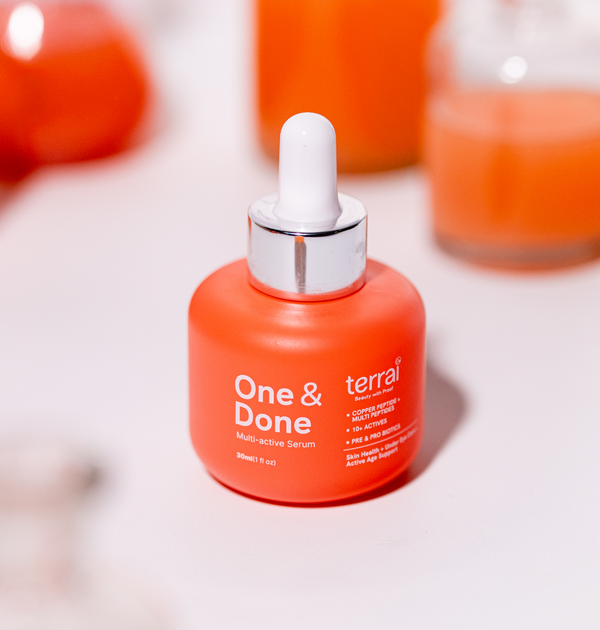
The One & Done Serum is built on the reasoning above. Rather than picking a side, it includes both niacinamide, positioned high in the ingredient list, and tranexamic acid, covering both routes in one step.
Around them sits a supporting cast that reflects the point about speed depending on more than the headline active: ethyl ascorbic acid, a stable vitamin C, plus green tea and bilberry extracts on the antioxidant side; sodium hyaluronate, olive squalane and saccharide isomerate for hydration; and a peptide complex including copper tripeptide-1 and acetyl hexapeptide-8 for barrier and firmness. Caffeine is included, which is the usual reason a serum can claim anything about under-eye puffiness.
The testing is published rather than implied. In-vivo clinical, hypoallergenic and skin irritation study reports are downloadable on the product page, worth reading if your skin reacts easily.
The brand's own instruction reinforces the point above: two to three drops morning and night, always paired with SPF in the morning. The rest of the Terrai skincare range sits alongside it.
The bottom line
Tranexamic acid has the stronger case for melasma and hormonal pigmentation. Niacinamide has the broader case for post-acne marks, uneven tone and barrier health, with almost no irritation risk. Neither has been proven superior to the other, and both are undone by skipping sunscreen.
If you are choosing between two single-ingredient serums, match the ingredient to your pigmentation type. If a formula gives you both routes in one step, the comparison stops being a decision you need to make.
FAQs
Which is better for dark spots, tranexamic acid or niacinamide?
Neither has been shown superior in a direct comparison. Tranexamic acid has stronger evidence for melasma, where it acts on both pigment production and the vascular component. Niacinamide has broader evidence for general hyperpigmentation and post-acne marks, with better tolerability. Match the ingredient to your pigmentation type.
Can you use tranexamic acid and niacinamide together?
Yes. They act at different stages, tranexamic acid on pigment production and niacinamide on pigment transfer into surface skin cells, so they complement rather than compete. Many serums formulate both together for this reason. Combining two mechanisms is more useful than doubling up on one pathway.
How long does tranexamic acid take to fade pigmentation?
Clinical trials of topical tranexamic acid for melasma typically run 12 weeks, with meaningful reductions measured at that point. Improvement is gradual rather than sudden. Results depend heavily on daily sun protection, since UV exposure reactivates the exact pathway the ingredient works to suppress.
Does niacinamide really work on hyperpigmentation?
Yes. Controlled studies have measured reduced hyperpigmentation and increased skin lightness against a vehicle control after four weeks of use. It works by blocking pigment transfer to surface cells rather than stopping production, and its effects on barrier repair and inflammation help prevent new marks forming.
Why are my dark spots not fading despite using a serum?
The most common reason is inconsistent sun protection, which undoes progress faster than any serum can make it. Other causes include stopping too early, irritating the skin with too many actives at once, or treating melasma with an ingredient better suited to post-acne marks.

More from the Journal
 A brightening serum gets added to the routine, skin turns pink, flaky or reactive within days, and the assumption is usually that the active...
 Sunscreen goes on the face every morning, and lips get skipped entirely, even though they're just as exposed to UV throughout the day. That...
 A brightening serum goes on for two weeks, nothing visible happens, and it gets shelved as "not working" right around the point it was...