

Why Skinimalism Is Winning: Do You Really Need a 7-Step Routine?
Seven products, four of them containing actives, applied in an order you half-remember from a video, and your skin is somehow more reactive than it was a year ago. Skinimalism is not a rejection of skincare. It is a correction, and the case for it is stronger than most trend pieces let on.
The short answer
No, you do not need seven steps. Most people get better results from four well-chosen ones.
Here is the part that rarely gets said out loud: while numerous studies have evaluated individual skincare ingredients, clinical evidence supporting the effectiveness of complete multi-step routines as a whole remains limited, and the necessity and added value of elaborate routines for the general population remain largely unknown.
The ingredients have evidence. The seven-step routine does not.
What skinimalism actually means
It is not doing less because less is fashionable. It is removing the steps that are not earning their place, so the ones that work can actually work.
Neither approach is automatically better. A skincare regimen works only if it maintains a healthy skin barrier and addresses the specific issues you have. A person managing melasma legitimately needs more than someone with unremarkable skin. The problem is not complexity itself. It is a complexity nobody prescribed.
What actually goes wrong with seven steps
Barrier disruption
Excessive or improper product use can cause skin irritation, barrier disruption, allergic contact dermatitis, photosensitivity, perioral dermatitis and acneiform eruptions. These risks are amplified when multiple products containing active ingredients are layered simultaneously.
The cruel part is what happens next. People experiencing these reactions usually respond by adding more products to fix them.
A delayed allergy you cannot trace
This one is genuinely under-discussed. Allergic contact dermatitis is a delayed immune reaction appearing 24 to 72 hours after exposure, commonly triggered by fragrances, preservatives and botanical extracts, including many marketed as clean or natural. You can use a product for months before developing sensitivity, and switching to a different product containing the same hidden allergen keeps the reaction going.
Across seven products you may be exposed to the same preservative or fragrance compound five times. Finding the culprit becomes nearly impossible.
Cleansers are not neutral
Surfactants used in cleansers can impair barrier function and contribute to dryness and irritation with frequent or excessive use. Double cleansing twice daily is four cleanses a day for skin that may not need one.
You cannot tell what is working
With seven variables changing at once, an improvement tells you nothing about which product caused it. Neither does a flare-up. You end up repurchasing everything because you cannot afford to test which one mattered.
The steps that actually carry weight
- A gentle cleanser. Once at night is enough for most people.
- One treatment step. This is where your actual concern gets addressed.
- A moisturiser suited to your skin type.
- Sunscreen every morning. The only step with unambiguous evidence behind it for both pigmentation and ageing.
Everything else is optional. Toners, essences, separate eye creams and dedicated barrier serums are additions, not requirements.
How to strip back without losing progress
- Pause everything except cleanser, moisturiser and SPF for two to three weeks. Skin needs that long to stabilise.
- Reintroduce one product at a time, waiting a week between each. This is the only reliable way to identify what your skin actually objects to.
- Keep sunscreen throughout. It is never the thing to cut.
- Judge on comfort, not drama. Success is skin that stops stinging and reacting, not a visible transformation.
- Exfoliate no more than two to three times a week, if at all.
Where multi-active formulas fit, honestly
Consolidating seven products into one is not automatically gentler, and any brand telling you otherwise is skipping a step. A single serum with eight actives still delivers eight actives.
What genuinely improves is everything around them. One preservative system instead of five. One fragrance profile, or none, instead of several. Fewer surfactants. Fewer variables when something goes wrong. And a routine simple enough that you actually follow it, which matters more than most people credit, because consistency beats sophistication every time.
The honest trade-off: if you do react to a multi-active formula, you cannot isolate which ingredient caused it. That is exactly why published irritation and sensitivity testing is worth more on a combination product than on a single-ingredient one.
Common mistakes
- Adding products to fix problems caused by products. The most common escalation cycle in skincare.
- Cutting sunscreen while cutting everything else. SPF is the step with the strongest evidence.
- Judging a simplified routine at one week. Give it a month.
- Assuming natural means non-irritating. Botanical extracts are among the more common contact allergens.
- Copying a routine designed for someone else's skin.
How One & Done fits this
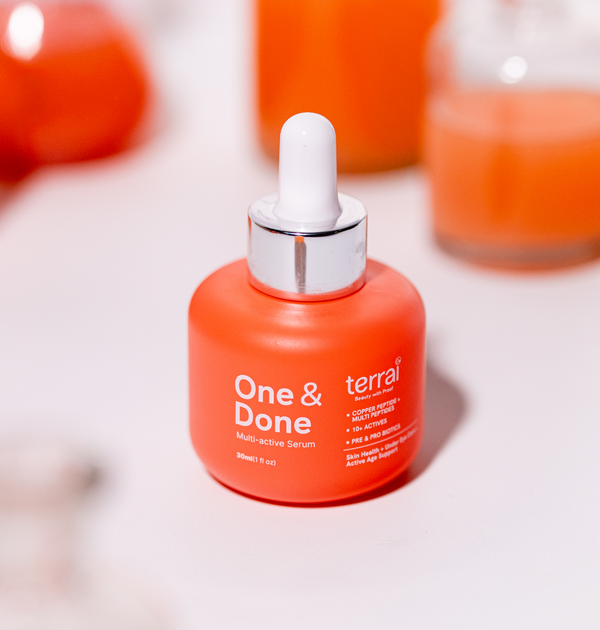
The One & Done Serum is designed for the treatment step in the four-step structure above, which is the step people usually split across three or four separate products.
It combines niacinamide and tranexamic acid for tone and dark spots, ethyl ascorbic acid plus green tea and bilberry extracts as antioxidants, sodium hyaluronate, olive squalane and saccharide isomerate for hydration, and a peptide complex including copper tripeptide-1 for barrier and firmness. Caffeine covers the puffiness claim.
Given the honest caveat above, the useful detail is that the tolerability testing is published rather than asserted. In-vivo clinical, hypoallergenic and skin irritation study reports are downloadable on the product page. For a formula asking you to consolidate several steps into one, that documentation is the thing worth checking.
Usage is two to three drops morning and night, always paired with SPF in the morning. The rest of the Terrai skincare range is built on the same multi-functional logic.
The bottom line
Skinimalism is winning because the evidence was always on its side. Individual ingredients are well studied. Seven-step routines are not, and the layering itself introduces risks that the individual products do not carry alone.
Cleanse, treat, moisturise, protect. Get those four right and consistent, then add something only when you have a specific reason and the patience to introduce it properly.
FAQs
Do you really need a 7-step skincare routine?
No. Most people get better results from four steps: a gentle cleanser, one treatment product, a moisturiser and daily sunscreen. Clinical evidence supports individual ingredients, but evidence for complete multi-step routines in otherwise healthy skin is limited, and layering multiple actives increases irritation and barrier disruption risk.
What is skinimalism?
Skinimalism is a shift towards fewer, better-chosen skincare products rather than elaborate multi-step routines. It is not about doing less for its own sake. The aim is removing steps that are not contributing, so the ones that address your actual concerns can work without competing or irritating the skin.
Is one serum enough for a skincare routine?
For the treatment step, often yes. A well-formulated multi-active serum can cover hydration, tone and barrier support in one layer. You still need a cleanser, a moisturiser and sunscreen. Look for published tolerability testing, since combination formulas make it harder to identify a trigger if you react.
How do I know if my routine is damaging my skin barrier?
Warning signs include products that suddenly sting on application, persistent redness, increased sensitivity to things you previously tolerated, flaking that does not respond to moisturiser, and skin that looks worse despite consistent care. Pare back to cleanser, moisturiser and sunscreen for two to three weeks.
Can I use too many skincare actives at once?
Yes. Layering multiple active products simultaneously raises the risk of irritation, barrier disruption and allergic contact dermatitis. It also makes it impossible to identify which product is responsible when something goes wrong. Introduce one new active at a time, allowing a week before adding another.

More from the Journal
 A brightening serum gets added to the routine, skin turns pink, flaky or reactive within days, and the assumption is usually that the active...
 Sunscreen goes on the face every morning, and lips get skipped entirely, even though they're just as exposed to UV throughout the day. That...
 A brightening serum goes on for two weeks, nothing visible happens, and it gets shelved as "not working" right around the point it was...