

Sunscreen for Combination Skin: Balancing Oil Control and Hydration
The forehead and nose are shining by midday, while the cheeks feel tight and look slightly flaky under the same sunscreen. That’s the everyday reality of combination skin, and it’s why so many sunscreens feel wrong on it: a formula rich enough for the dry areas turns greasy on the T-zone, while a mattifying one leaves the cheeks parched. Choosing a sunscreen for combination skin means finding a formula that works for both zones at once, then building a routine that keeps that balance through the day.
Combination skin generally does well with a lightweight, water-based sunscreen that hydrates through humectants rather than heavy oils, with SPF 50+ and PA++++ for daily sun protection for face. Humectants like hyaluronic acid give dry areas the water they need without adding the grease that oily areas don’t want.
For the hours after that, a hydrating face mist with SPF is a practical second step. It refreshes drier areas, tops up protection, and doesn’t add heaviness to the T-zone the way a second layer of cream would.
What makes combination skin tricky for sunscreen
Two skin types on one face
Combination skin usually means an oilier T-zone (forehead, nose and chin) with normal or drier cheeks and outer face. The T-zone has a higher concentration of oil glands, so it produces more sebum, while the cheeks produce less and lose moisture more easily.
Most sunscreens are formulated with one skin type in mind. A rich cream base built for dry skin relies on oils, butters and waxes that feel comfortable on cheeks but slide and shine on the T-zone. A strongly mattifying base built for oily skin can draw moisture from areas that never had much to spare.
Oily is not the same as hydrated
The shine on the T-zone can be misleading. Oil (sebum) and water (hydration) are different things, and skin can produce plenty of oil while still lacking water. When combination skin gets dehydrated, oil production often increases rather than decreases, which makes the T-zone shinier and the cheeks tighter at the same time.
This is why stripping combination skin with harsh, drying products tends to backfire. Our guide on barrier-first skincare and why fixing dehydration comes first explains how dehydration and barrier damage feed each other.
The middle of the day is where balance breaks
Even a well-matched sunscreen shifts through the day. Sebum builds on the T-zone and starts breaking down the protective film there, while the cheeks gradually lose hydration. By early afternoon, one zone needs blotting and the other needs moisture, and both need their sun protection topped up.
What to look for in a sunscreen for combination skin
- A water-based or fluid texture. Light formulas sit comfortably across both zones without loading the T-zone with oil.
- Humectant-led hydration. Hyaluronic acid and glycerin draw water into the skin, which helps drier areas without adding greasiness.
- Lightweight emollients rather than heavy oils. Ingredients like squalane support the skin barrier without the weight of thicker oils and butters.
- SPF 50+ with PA++++. SPF covers UVB, which causes burning, while the PA rating covers UVA, which drives tanning and pigmentation. Both matter every day. For a closer look at what these numbers mean, read our guide on SPF 50 and PA++++ ratings .
- Non-comedogenic testing. Since the T-zone is more prone to congestion, a formula tested not to clog pores is worth prioritising.
- No white cast. A sunscreen that disappears into the skin is one you’ll apply generously, and generous application matters more than any other factor.
A simple sunscreen routine for combination skin
Instead of applying more product to fix both zones, use two light steps that do different jobs.
Morning: one even layer
- Cleanse with a gentle face wash that doesn’t leave skin feeling tight.
- If your cheeks need extra moisture, apply a light gel moisturiser to the drier areas only, and let it settle for a minute.
- Apply a water-based sunscreen to the whole face and neck, about two finger-lengths of product, 10 to 15 minutes before stepping out.
- Press a little extra onto the cheeks if they tend to feel dry, rather than adding more to the T-zone.
Midday: rebalance and top up
- Blot the T-zone with blotting paper instead of wiping, so you remove oil without stripping the sunscreen underneath.
- Mist an SPF face mist evenly over the face, holding it at a short distance. The drier areas get a hit of hydration, and the whole face gets a protection top-up.
- Let it dry down before touching your face or applying anything else.
This split approach lets each step solve its own problem, rather than asking one product to do everything at once. If you’re unsure whether a mist can really stand in for cream during the day, our guide on sunscreen mist vs cream covers how the two work together.
Common mistakes with combination skin
- Choosing sunscreen for the oiliest area only. A heavily mattifying formula can leave cheeks dry and tight by the afternoon.
- Choosing sunscreen for the driest area only. A rich cream may feel good on cheeks but tends to slide and shine on the T-zone.
- Using less sunscreen on the T-zone to avoid shine. Under-applying reduces protection on the area that gets the most direct sun.
- Wiping away oil before reapplying. Wiping removes sunscreen along with oil. Blotting is gentler and keeps more of the protective layer in place.
- Skipping hydration because some areas feel oily. Dehydrated combination skin often responds by producing more oil.
- Applying only once in the morning. Sebum and moisture loss both change how protection holds up across the day. Our guide on how often to reapply sunscreen explains what the 2-hour guideline really means.
How the Aqua Radiance and Hydra Glow Mist routine works for combination skin
The two-step routine above maps directly onto two products from the Terrai sun care collection .
Step 1: Aqua Radiance Sunscreen as the morning base
The Aqua Radiance Sunscreen is a water-based SPF 50+ PA++++ formula with a watery texture, which suits the light, even base layer combination skin needs. Hydration comes from hyaluronic acid, olive squalane and vitamin C rather than heavy oils, so drier areas get moisture without the T-zone getting greasier. The brand states zero white cast and water resistance for up to 80 minutes, and test reports covering SPF and PA rating, water resistance, non-comedogenic status and dermatological testing are published on the product page.
Step 2: Hydra Glow Mist for midday balance
The Hydra Glow Mist is a hydrating face mist with SPF 30 PA+++, which makes it a natural fit for the midday step. It adds moisture where combination skin starts to feel tight, refreshes the face, and tops up sun protection over sunscreen or makeup without the heaviness of a second cream layer.
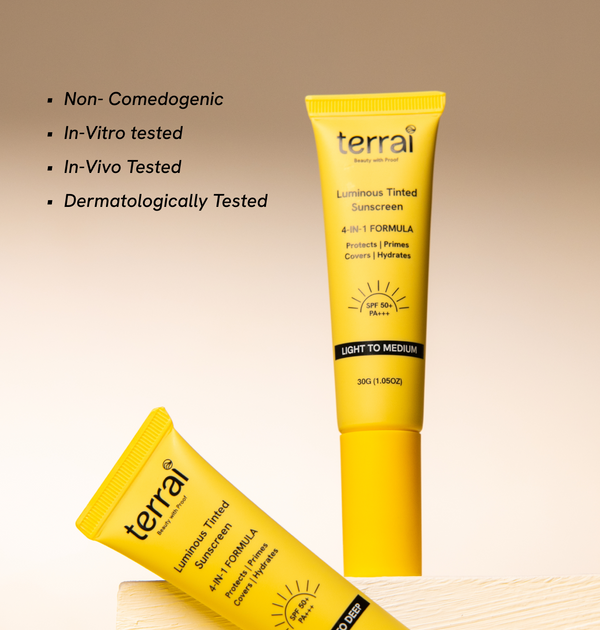
Used together, the two cover both sides of combination skin: a light, hydrating base in the morning and a refreshing top-up when the balance starts to shift. If you prefer some coverage in the mix, the Luminous Tinted Sunscreen is a tinted sunscreen for combination skin that wants to even out tone, and our guide on choosing a sunscreen shade that matches your skin tone can help you pick a shade.
All products are formulated and made in house by Terrai .
Quick checklist for combination skin
- Water-based or fluid sunscreen with SPF 50+ and PA++++
- Hydration from humectants, not heavy oils
- Non-comedogenic testing you can check
- No white cast in daylight
- Light moisturiser only on dry areas, if needed
- Blot, don’t wipe, the T-zone during the day
- A hydrating SPF mist for midday top-ups
Final word
Sunscreen for combination skin works best when it treats both zones fairly: light enough for the T-zone, hydrating enough for the cheeks, and backed by a midday step that restores the balance as the day goes on. A water-based base and a hydrating SPF mist do that more comfortably than any single heavy or mattifying formula.
If this two-step approach fits your skin, explore the sun care collection and build your routine around the Aqua Radiance Sunscreen and Hydra Glow Mist.
FAQs
What type of sunscreen is good for combination skin?
A lightweight, water-based or fluid sunscreen usually suits combination skin. Look for SPF 50+ and PA++++, hydration from humectants like hyaluronic acid rather than heavy oils, and non-comedogenic testing. This keeps the T-zone comfortable while still giving drier cheeks the moisture they need.
Can combination skin use sunscreen without moisturiser?
Often yes, if the sunscreen already contains humectants such as hyaluronic acid. If your cheeks still feel tight after applying it, add a light gel moisturiser to the drier areas only, rather than across the whole face, so the T-zone doesn’t become greasy.
How do I stop my T-zone getting oily under sunscreen?
Choose a water-based sunscreen without heavy oils, apply it in an even layer, and blot the T-zone with blotting paper during the day instead of wiping. Wiping removes sunscreen along with oil, while blotting keeps more of the protective film in place.
Is a face mist with SPF good for combination skin?
Yes, as a midday step. A hydrating face mist with SPF adds moisture to drier areas and tops up sun protection without adding the heaviness of another cream layer. It works best alongside a sunscreen applied in the morning, not as the only protection for the day.
Should combination skin use tinted sunscreen?
It can, if you want light coverage alongside protection. A tinted sunscreen evens out tone across both zones and makes reapplication easier over the day. Choose a shade that matches your skin in natural daylight, and a lightweight texture that doesn’t sit heavily on the T-zone.

More from the Journal
 Sunscreen goes on at 8 am, and by lunch nobody has touched it again. Some people are certain it’s still working. Others think it...
 A brightening serum gets added to the routine, skin turns pink, flaky or reactive within days, and the assumption is usually that the active...
 Sunscreen goes on the face every morning, and lips get skipped entirely, even though they're just as exposed to UV throughout the day. That...